History & Finance
Exchanges
The Vancouver trading floor that financed British Columbia's mines — and became the epicentre of speculative junior equities.
The history of the Vancouver Stock Exchange, from 1907 to 1999, is both a success story and a cautionary one. It gave British Columbia a way to raise venture capital for resource exploration, and over time it also earned a difficult reputation.
Origins
Early Days
After the gold, silver and copper rushes that began in British Columbia in the 1860s, most share trading in BC mining properties went through the Spokane, Montreal and Toronto exchanges. Local promoters and founders wanted to raise capital in Vancouver instead.
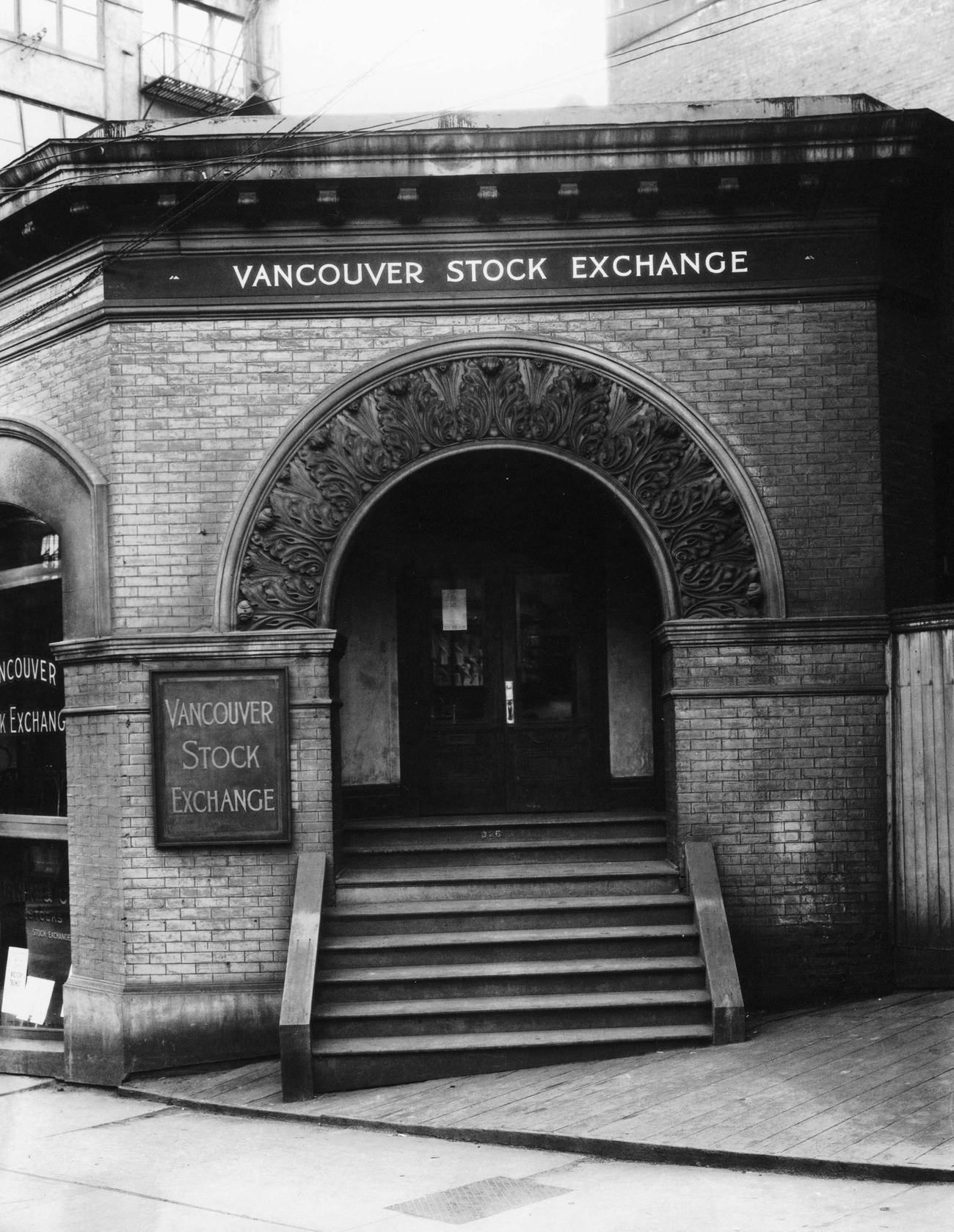
A provincial private member's bill created the exchange on 25 April 1907, and trading opened on 1 August that year in a small timber building at 849 West Pender Street, with Charles D. Rand as its first president and Vancouver business leaders as charter members. Fourteen companies were listed on the first day, and three trades took place. Membership initially cost a few hundred dollars; by late 1910, as the exchange became established in the business community, the fee had risen to $3,000.
The Case For
The Good
Modest listing requirements allowed speculative junior mining companies to join the exchange and raise money. That momentum carried on for decades, and Vancouver became the centre for resource financing in Canada.
This mattered because mineral exploration is expensive and most of it fails. Without a public market willing to fund long odds, few claims in the province would ever have been drilled. Several significant discoveries were financed this way. The promoter Murray Pezim used Vancouver shells to fund two prospects that banks and major mining companies had turned down: the Hemlo gold field in Ontario, in 1981, and later Eskay Creek in British Columbia's Golden Triangle, one of the highest-grade silver-gold deposits of its era.
The Case Against
The Bad
As enthusiasm grew, some promoters took advantage of the exchange's momentum and its minimal disclosure requirements. Worthless ground — "moose pasture" in the trade — was listed, and vague press releases drove enthusiastic retail buying before companies disclosed less promising results. Retail investors suffered, and the exchange's reputation suffered with them.
The scale of the problem was documented at the time. In 1973 the RCMP estimated that between twenty and thirty percent of companies listed on the exchange were involved in some form of fraud. In 1989 Forbes magazine labelled it the scam capital of the world. A 1994 provincial report referred to shams, swindles and market manipulations. The exchange nonetheless remained substantial: in 1991 it listed roughly 2,300 stocks and handled around four billion dollars in annual trading.
The Turning Point
The Ugly
Fraud and market manipulation escalated. The 1997 Bre-X Minerals scandal — though that company was listed on the Alberta and Toronto exchanges rather than in Vancouver — caused deep distrust of the junior mining sector and contributed to the restructuring that ended the Vancouver exchange's independent existence.
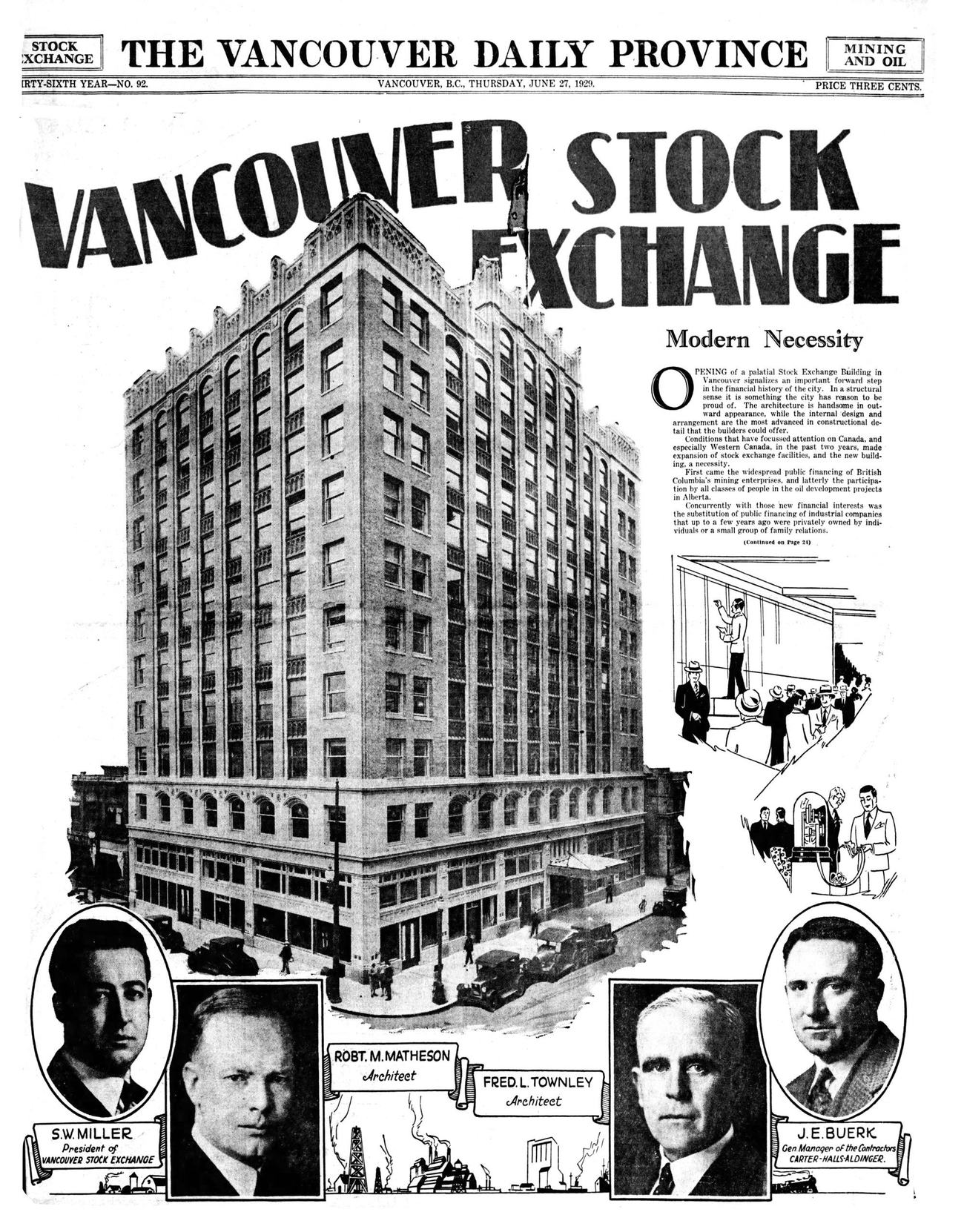
On 29 November 1999 the Vancouver Stock Exchange merged with the Alberta Stock Exchange to form the Canadian Venture Exchange, taking on the small-cap listings of the Bourse de Montréal at the same time. The old Vancouver trading floor became the new exchange's floor. In 2001 the Canadian Venture Exchange was bought by the TMX Group and renamed the TSX Venture Exchange.
It is worth being precise here, because it is often misremembered. The Vancouver Stock Exchange did not become the Toronto Stock Exchange. It became the TSX Venture Exchange — the junior market, where early-stage companies raise money. The Toronto Stock Exchange is the senior market, and companies that succeed on the Venture Exchange can graduate to it. Both are now operated by the same parent company.
Reform
The Change
New rules followed. The most consequential was National Instrument 43-101, Standards of Disclosure for Mineral Projects, introduced by the Canadian Securities Administrators in the wake of Bre-X and in force from November 2000. It requires that technical and scientific disclosure about a mineral project be prepared by, or under the supervision of, a Qualified Person — a certified geologist or engineer who must, in certain circumstances, be independent of the company and the property. Failure to comply can bring fines, loss of licence, or prosecution for misleading disclosure. Further disclosure rules and promoter bans have tightened standards since.
Safeguards
Governance
Drill core security audits are now standard practice to guard against the kind of sample tampering seen at Bre-X. Each core is tagged, photographed, halved and archived under strict chain of custody, with the other half sent to an independent laboratory. Inconsistencies trigger audits designed to detect discrepancies in the weight, purity or chemical fingerprint of gold at each stage of extraction.
Legacy
What It Left Behind
In its early years the Vancouver Stock Exchange created a route for prospectors to identify and develop projects, including major deposits that might otherwise never have been found. Today the TSX Venture Exchange operates with a far stronger system of checks and balances, giving investors confidence while still providing companies with a way to raise venture capital.
Terms
A Short Glossary
Listing — A company sells shares to the public on an exchange in order to raise money. A listed company's share price responds publicly to news, good or bad, and its management answers to shareholders and regulators.
Promotion — The work of building investor interest in a stock. On the old Vancouver exchange this was an industry in itself.
Moose pasture — Trade slang for a mineral claim with no realistic prospect of producing anything.
Shell — A listed company that no longer carries on meaningful business, retaining little beyond its listing.
Reverse takeover — A private company obtains a public listing by taking over a shell. It is legal and common, and it is also a fast way to acquire a public vehicle with comparatively little scrutiny.
Short selling — A bet that a share price will fall. Shares are borrowed and sold, then bought back later, ideally at a lower price. Profitable if the price drops, costly if it rises.
Qualified Person — Under NI 43-101, the certified geologist or engineer who must prepare or supervise a mining company's technical disclosure and take responsibility for it.
Disclosure — Listed companies are required to tell the market about material events. Failing to disclose something significant is a regulatory matter.
Learn More
More articles and archival photography on the Vancouver Stock Exchange are on their way.